
Schedule a Consultation
Our job isn’t over until the patient is smiling
Contact Us
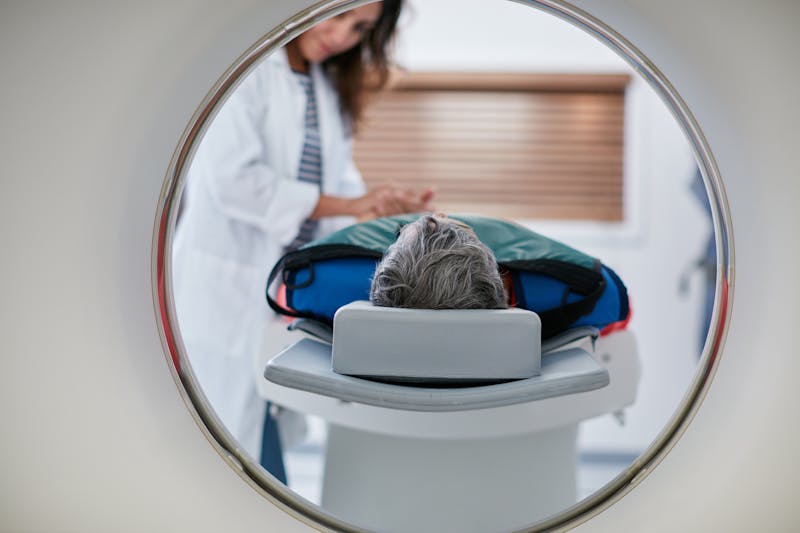
Facial weakness can be brief and benign, or it may be the first sign of a condition that requires urgent, specialized attention. The difference is often invisible to the naked eye. That’s where modern imaging changes the story.
At Hadlock Facial Plastic Surgery in Boston, Dr. Tessa A. Hadlock brings the perspective of a Harvard Medical School professor, an NIH-funded clinician-scientist, and a long-time director of the Facial Nerve Center. With decades focused on facial paralysis and facial reanimation, we use imaging thoughtfully: not as a reflex, but as a precision tool to uncover the “why” behind weakness and guide the safest next step.
Facial weakness is a symptom with many possible causes, some of which are temporary, some structural, and some progressive. A careful examination and history often point strongly toward the likely cause, and many patients do not require immediate imaging if the presentation fits the classic symptoms of Bell’s palsy.
However, when features don’t behave like Bell’s palsy, clinical guidelines emphasize the importance of accurate diagnosis, appropriate follow-up, and reassessment. Imaging becomes most valuable when we need to answer one of these high-stakes questions:
When used at the right time, imaging doesn’t just “take pictures.” It maps the course of the facial nerve, identifies where it’s being affected, and helps predict what kind of recovery is realistic.
MRI is the workhorse for evaluating the facial nerve and nearby brain/inner ear structures because it excels at soft tissue detail and contrast enhancement. In facial nerve-related weakness, evidence-based imaging guidance often favors MRI (with and without IV contrast) as the initial study of choice in key scenarios.
MRI can help detect:
High-resolution CT scans of the temporal bone are commonly used to assess the facial nerve canal and the surrounding bone, particularly when there are concerns about lesions in the ear or temporal bone area, or when planning for surgery. CT imaging can display canal expansion, erosion, and the characteristic "fingerprints" that certain lesions leave on the bone (The Many Faces of Facial Nerve Schwannoma | American Journal of Neuroradiology).
In real-world facial nerve care, MRI and CT are complementary: MRI reveals the lesion, while CT provides its bony context and surgical terrain.
Red flags we take seriously include:
A careful clinical exam remains foundational; many specialized centers emphasize that imaging is most powerful when paired with targeted facial nerve evaluation (including hearing assessment and focused head and neck exam) (UCSF Facial Nerve Center—Diagnosis approach).
Facial nerve schwannomas are typically slow-growing, benign tumors that can arise anywhere along the facial nerve’s path.
Their imaging appearance is often described as an enhancing lesion along the nerve with associated canal enlargement (Diagnostic and Interventional Radiology pictorial essay PDF).
How imaging helps
Why it matters clinically
These lesions—often centered at the geniculate ganglion—are benign vascular malformations that can mimic other causes of facial weakness.
They may present as slow-onset weakness or recurrent episodes on one side, making them a key consideration when symptoms repeat.
Radiology standards often require both CT and MRI for confident diagnosis and planning.
How imaging helps
Why it matters clinically
Facial weakness can significantly impact your ability to communicate, connect with others, and perceive yourself. Modern imaging techniques, when used thoughtfully, can uncover the underlying causes of atypical patterns, slow recovery, or rare conditions such as facial nerve tumors when detected early. It is essential to combine imaging with a deep understanding of facial nerve issues to ensure that the outcomes lead to the correct decisions, rather than confusion or delays.
If you are experiencing progressive or recurrent facial weakness, along with symptoms related to hearing or balance, or if your condition isn't improving as expected, we are here to help. Schedule a consultation today at Hadlock Facial Plastic Surgery in Boston.